Wednesday, January 24, 2018

Super One More Jump (Switch) [Review]

Product provided by developer - Opinions are my own.
Super One More Jump may look like another Meat Boy-inspired platformer, but it doesn't really play like one. This game is actually an auto-run platformer which uses single button controls to make your character jump as he/she/it hurtles ever onward across, around, and beneath obstacle courses of platforms and hazards.
The complexity of being able to change your speed and direct your jumps that is present in most other platformers is nowhere to be found here, meaning that the gameplay is quite simplistic. On the other hand, this lack of mobility also adds to the difficulty since you're given no time to stop and think, and no way to correct mistimed jumps in midair. You can't even change your jump height by holding the jump button for different amounts of time. As such, Super One More Jump's gameplay is fully committed to a design where timing is everything. What appears to be a platformer to an onlooker is, in practice, actually comparable to a single-button rhythm game - except instead of tapping to music, you're tapping to visual cues. And really, most of the obstacles and platforms are just visual cues. With the single button controls, most levels could just as easily be laid out flat without functionally affecting the gameplay, but it's the twisty, bouncy orientations of the platforms that make the relatively simple platforming more challenging, and entertaining, to decipher on the fly. Because of this, even though you may as well be running and jumping on a flat autoscrolling platformer in most cases, it looks and feels as though you're doing something much more complex and impressive.
(Click to enlarge)
Super One More Jump features over 140 levels of increasing difficulty, as well as several modes. Each of the levels in the main set contains three optional collectibles for an extra challenge, which can be used to unlock character sprites for each of the ten pixel art graphic themes that can be changed at any time. When a level has been cleared with all three collectibles, three additional modes are unlocked for that level. Unfortunately, none of these modes (Mirror, Night, and Rotation) really affect the gameplay much at all. Mirror just flips the level, which changes nothing, Rotation constantly spins the camera as a distraction, and Night limits visibility. You can try to clear every level in every mode, but that really just feels like playing the same level four times. It's worth mentioning that there is also a practice mode, which will let you slow down movement and try out levels without adding to your death counter.
Circuit mode. It's like Endless, but in a box.
Additional modes include Endless and Circuit, which are both semi-randomly generated endless running modes that track your high score. Endless plays like an infinite level from the main game, while Circuit is contained inside a box which swaps out walls as you go around the inside edge for as long as you can. There's also "Vault" mode, which seems to just be an additional set of levels without the collectibles, as well as a mysterious unlockable post-game skull mode.
2P Endless Mode
Lastly, there are the multiplayer options: 2P Endless and 2-4P Co-op. 2P Endless mode splits the screen horizontally and pits two players against each other to survive as long as possible in an endlessly randomized platforming course. The co-op mode is arguably the most interesting mode of the bunch, and it's a shame that it's limited to multiplayer as it would work quite well on a single controller as well. In this mode, there's only one character running through individual levels, but each surface is color-coded for a particular player. The character will only jump when the correct player pushes the jump button - for example, if you're on a green platform, only Player 2 can jump. The streak of successful jumps is tracked across levels, and any death or jump from the wrong player will break the streak. This is a good mode for blaming your failures on your friends.
"Night" mode
The Final Word
You have to go into Super One More Jump knowing what you're getting: a challenging, single-button, auto-run platformer. While mechanically simple, the timing-based gameplay forces you to react quickly and precisely without the crutches of slowing down to think, or adjusting a jump. Though much of the twisty level design is merely for show, the "show" does add to the difficulty by making you think harder to understand upcoming obstacles, and creates a satisfying spectacle when you do successfully complete a run. The multiplayer offerings aren't half bad either, and it's accessible for one-handed players as a nice bonus. Hardcore platforming game players might be disappointed by the lack of complexity in the gameplay, but I think there's still enough challenge, style, and content to satisfy most.

Tuesday, July 18, 2017

Splatoon 2 - Worthy of being called a sequel

Product provided by Nintendo
(Disclaimer: As of the posting of this review, I have yet to play Rainmaker and Tower Control
due to a lack of players pre-release, as well as matches with friends due to a lack of friends and mobile app)

If you're already a fan of Splatoon, you probably already know most of the important things about Splatoon 2, and you're going to like it. It's generally more of the same, but better. And it's not just a port of the Wii U game; it's a fresh new can of squid (that's a good thing).

For those who aren't aware of how Splatoon works... It's a family-friendly third-person shooter in which the player controls an Inkling - an ink-shooting squid-person - which can transform into squid form and swim through its own-colored ink for fast movement across the ground and up walls. The objectives vary across the game's many modes, but to simplify things for the moment, you'll either be using the clever inking gameplay in the single player adventure to do platforming and combat against computer-controlled enemies to progress to the end of each stage, or you'll be playing with teams of real people online and competing against other teams or waves of non-player enemies.
Since each mode comes more or less in a self-contained chunk of game, let's go into some details on them one at a time:

Octo Canyon (Single Player)
I already wrote a preview article about Octo Canyon, and though I had yet to finish the adventure at the time of writing, the opinions and details still hold true now. When I played the first Splatoon, I was blown away by the single-player level design, but Splatoon 2's makes the original feel bland in comparison. The level design is still top notch and satisfying, but there are a lot of new gameplay elements to mix things up this time around, from grind rails to boost pads to orbs you can shoot and warp to. What really adds to the depth though, is that any level can be played with any weapon type (once you've progressed far enough to unlock that weapon type), and each level's completion is tracked per weapon. And for those who aren't familiar, Splatoon's various paint-themed weapons each handle in unique ways and with different combinations of sub-weapons (throwable ink bombs) and special weapons that often totally change up the style of gameplay. Anyway, check it out the preview for more details on Octo Canyon. Seriously, just because this paragraph is a small percentage of the review, don't discount Splatoon 2's single-player mode; it's a significant part of the game and it's fantastic.

Multiplayer
When you first enter the game, after an unskippable announcement of the current level rotation (each mode is limited to two maps at a time, which rotate out every two hours), you'll find yourself walking around a city hub area. Here you can buy new weapons and gear once you reach the appropriate level, exchange tickets for temporary experience buffs and other bonuses, enter online multiplayer lobbies, create a local multiplayer lobby, scan in amiibo for rewards of gear, music, and screenshots, enter Octo Canyon, and even play an impressively challenging rhythm game in the Sound Test.
"I'd better just try this for the review," I thought.
And then I played for over an hour.
The gear that you can buy to make your Inkling look spiffy also comes with valuable bonus abilities in battle, such as faster ink refilling, stealth when jumping to a teammate's location after respawning, higher swim speed, and many more. Each piece of gear has one visible bonus and up to three additional bonuses which are randomized and unlocked as the gear is used online and leveled up. In the first game, this resulted in a whole lot of luck and grinding if you wanted to get gear that both looked cool and had your preferred strategic set of abilities. This time around, there are couple options to ease the process: bonus attributes can be scrubbed from gear and then reattached to other gear (for a fee of in-game money), and there's a character who sells items which increase the likelihood of a particular bonus being unlocked next. It still seems like it'll take a lot of effort to get what you want, but it ought to make building a strategic loadout more dependent on the player and less about luck.
(Click to enlarge)
Returning Modes
As a beginner, the only modes you'll be able to play are Octo Canyon and Turf War. Turf War is the original, simple challenge of covering more ground in your team's color of ink than the enemy team within the time limit. The simple concept turns out to have more depth than it might first appear, because you'll want to be attacking enemy players at the same time to delay them from covering any more ground, and some weapons are better suited for quickly creating paths for your teammates rather than covering large areas in ink. It often tends to feel like the last 45 seconds is all that really matters in this mode, but what does a noob like me know anyway.

Once you've played enough of Turf War to get to Level 10, Ranked Battles become available. These make use of one of three returning modes: Splat Zones, Tower Control, and Rainmaker (once again, one mode at a time and two levels at a time, changing out every two hours). Each ranked mode has slightly more complex objectives, and has had some updates and gameplay tweaks since its appearance in Splatoon. To summarize though, "Splat Zones" matches have two teams fighting over control of a smaller area rather than the entire map, and the winner is whoever can hold the territory for a certain total amount of time. "Tower Control" challenges players to ink and ride a moving tower across the map and push into the goal on the opposing team's side. And finally, "Rainmaker" is a fight to capture a sort of super weapon, the Rainmaker, and bring it into the target area of the enemy team's base. It's kind of like capture the flag, but the flag is a gun.
In Splat Zones, team fight to control a much smaller area, so it's extra important to "splat" the opponents.
Anyway, since these are ranked modes, winning will increase your rank and losing decreases it. New to Splatoon 2, each mode has its own rank as well, so you're allowed to be bad at Rainmaker without hurting your record for Tower Control. Additionally, if you're able to reach rank B- or higher, League Battles become available. With these, you can compete with a group in the Ranked Battle modes over the course of two hours to try to achieve the highest rank with everyone starting from scratch each time. This way, you once again can play without the pressure of needing to maintain a good record, and it gives players who have maxed out their rank something else to do.

Salmon Run
Finally, we have Salmon Run, a new cooperative mode where a team of up to four players fights against waves of computer-controlled enemies with the goal of defeating boss enemies and taking their golden eggs back to a repository. This mode is somewhat randomized each time because players are forced to use a different weapon with each wave, the water level and repository location can change, and the location and type of enemies varies. It can be a challenge, especially with less than a full team, since the game ends if the entire team is defeated or if not enough golden eggs from the boss enemies are collected during the wave's time limit. This mode also ranks you based on your success over time, and rewards you with money and items for reaching certain point thresholds. Unfortunately, this mode is only open during certain time periods for public play, but you can still meet up with friends in real life for local multiplayer and play any mode and any level, regardless of the current rotation on the server.


Miscellaneous Tidbits
Everything listed so far is what Splatoon 2 primarily consists of as a game, but you probably knew most of that already, and there are a few more details worth mentioning:

With the game's release, a mobile app will also be available which will allow players to organize teams with friends, voice chat, and order unique gear. Since that's not available yet, I don't know anything beyond what's already been publicly announced.

Amiibo can be used once again, and all I know for sure is that the Inkling amiibo from the first Splatoon unlock the same gear they did in the first game, in addition to music for the sound test rhythm game, and the ability to pose your character with the amiibo character in the city for cool screenshots. Another very useful feature of amiibo is that you can store a weapon and gear loadout set, along with your control settings, to an amiibo and then scan it in again to instantly switch to that set. I imagine this would be very convenient for tournaments (though amiibo scanning can be disabled in the local multiplayer options if tournament organizers desire), but it's a bit odd that saving favorite loadouts and control profiles is locked behind amiibo rather than being freely available functionality.
And finally, like the first game, free updates of new gear and stages will be made available over the course of the year following Splatoon 2's release. The number of maps currently available feels acceptable (eight for competitive multiplayer and two(?) for Salmon Run), but having more on the horizon ought to keep things fresh for a while.


The Final Word
It's not wrong to say that Splatoon 2 is mostly more of the same, but it's hard not to be without drastically changing what made the first game so fun. Even though most of the modes are very similar to the first game's, the absence of certain special weapons, addition of new ones, new levels, more convenient gear customization,  Octo Valley's many new gameplay elements, and Salmon Run, there's enough newness here to make it all feel fresh again. When all I had seen was the Nintendo Direct announcements, I feared that Splatoon 2 would be more like Splatoon 1.5, but now that I've played it, I'm pleased to have found it worthy of being called a full sequel.

Tuesday, July 11, 2017

Splatoon 2 - Give Single-Player Some Love (Preview)


Product was provided by Nintendo.

Much of the focus when talking about Splatoon always ends up landing on the multiplayer portion of the game. That makes sense, considering it is the game's most advertised point and it's what you spend the most time playing after finishing the single-player campaign. But unlike most online multiplayer-centric games these days, Splatoon, and now Splatoon 2, have as well designed of a single-player experience as one would come to expect from any offline Nintendo game. I was blown away by how well the gameplay of inking surfaces for movement combined with shooting for a unique action platforming experience in the first game, and after a few worlds of Splatoon 2's single-player adventure, I'm loving it all over again.
Shooting one of these targets causes objects to move.
Splatoon 2's Octo Canyon mode is arranged much like the first game's Octo Valley. Several hub areas house a handful of levels each which must be cleared before that world's boss stage becomes available. Even the hubs are like small levels though, as each stage entrance is initially hidden and often requires you to perform some platforming and exploration before shooting and revealing the entrance. This time, Marie, the celebrity squid from the first game, helps you on your quest by dropping the knowledge on all the new weapon types and their new functionality (for example, flinging ink in a narrower, vertically oriented line when jumping with a Roller, or using the new Dualies' dodge roll to instantly activate and ride a grind rail). Her and other characters' dialogue is also pretty darn amusing, so that's another plus.
Nearly every level I've played so far introduces new gameplay elements that weren't present in the first game (and a few that were) and then expertly builds on the concept with more complex level design as you progress. To give a few examples, the first game's "Inkrails" have been upgraded to Grind Rails, which allow for shooting, swimming, jumping, and bombing while riding them. There are "Grapplinks", glowing orbs which warp you to them when shot. Also, "Inkfurlers", which extend like party noisemakers when shot with ink, creating a temporary path and mowing down enemies along the way. And these are just a few examples from the first few chapters of Octo Canyon.


The single-player adventure would be fun enough as it is, but what really brings it above and beyond is the ability to use any weapon type in any stage (once unlocked), and have each completion tracked with an icon in your stats menu and at the level entrance. Weapons are unlocked for single-player as you progress when, on particular stages, Sheldon will send in a new type for you to try. After clearing that stage, the weapon will then be available for use on any other level. These levels are usually designed with the newly introduced weapon in mind, so I found that I ended up quickly learning to use things that I hardly bothered to touch in the first game. Furthermore, using a different weapon often means that you'll need to find a new method for success and some levels even have minor redesigns to accommodate you when playing through again with something different. Each weapon can also be upgraded with the plentiful orange orbs and hidden trinkets hidden throughout this mode, although the upgrades are surprisingly expensive, meaning that you'll need to replay levels with the other weapons if you want to get all the upgrades. To be clear though, these upgrades only work in Octo Canyon, so it's not like you'll need to grind offline for online success. (I'm not exactly clear on whether or not you need to use a weapon type in single-player to unlock it for mutliplayer though...) Unfortunately, these upgrades can only be performed at a particular location in the World 1 hub, and even though you can warp to it or any level you've unlocked from the menu, each hub is separated by a loading screen this time around, so chances are you won't want to be checking your available upgrades between every single level. (Also, chances are low for finding a way to skip a whole world this time around, speedrunners!)
Speaking of speedrunning, your fastest time on each level, along with which weapon you used to achieve it, is also tracked on the stats menu. At the point I'm at, there's not really any incentive for speedrunning stages, or any online leaderboard for times, but something about seeing that "New Record" pop up really makes me want to go back and play everything faster. Now if only there was an update to have the timer show fractions of seconds and keep records for each weapon on each level... please? Update: The mobile app shows your best times per weapon per level!!

Wednesday, October 5, 2016

Paper Mario: Color Splash [Review]

This product was provided to me by Nintendo. Opinions are my own.
It's the game hated by the masses as early as its first reveal trailer, and now it's here to make those conclusion jumpers eat their words. Well, partially at least.

Color Splash is indeed reminiscent of Sticker Star in many ways, but it improves on the Sticker Star formula almost everywhere. It ought to go without saying (but clearly it doesn't) that one's enjoyment of Paper Mario: Color Splash is likely to come down to personal taste. Therefore, as you should with every game review, you should be reading this review to understand what the game is like in order to make your own prediction about whether you'll like it based on your tastes in games.

The Story
Our story begins with Mario and Princess Peach receiving a letter which actually turns out to be a paper Toad, cruelly folded up into an envelope and drained of its color. With their detective-like deduction skills (of checking the postmark), Mario and Peach head off to Port Prisma to investigate, only to find the town vacant and filled with spots drained of color. To make a short story shorter, Mario gets a floating paint bucket companion who imbues his hammer with the ability to splash paint and restore color to the world, and the two of them go on a quest to retrieve the Big (and mini) Paint Stars and stop whoever is behind the army of color-slurping Shy Guys (gee, I wonder who it could be). That's the plot, and although the game takes a good 25 hours or more to finish, the story only slightly develops beyond that point for the entire game. Even though Peach periodically sends letters and the Big Paint Stars show you their memories after you save them, these all end up being just a tease at a plot that could have been, and rarely actually provide any new information.
This is where I'd put my plot... IF I HAD ONE!
However, while the main story is rather thin, the game's structure of being divided up into many levels on a map screen results in many shorter stories that span one to four areas a piece. They're all just arbitrary objectives that happen to get you to the next Paint Star for one reason or another, but they're also all quite charming and filled with unique characters (well, pretty much they're all Toads, but these Toads have more personality than ever). It also can't be overstated how well done the game's writing is. The English translators did a fantastic job of giving everyone memorable personalities and filling the dialogue to the brim with humor that'll appeal to a variety of players. Not only is the writing laugh-out-loud funny, but there are many situations, puzzles, and animations that serve no other purpose than to add humor to the game. It's the sort of thing that you wouldn't expect the designers to put the time and effort into, but the fact that the setups for humor are more elaborate than usual from a game design standpoint makes them all the more unexpected and amusing.

The Overworld & Gameplay
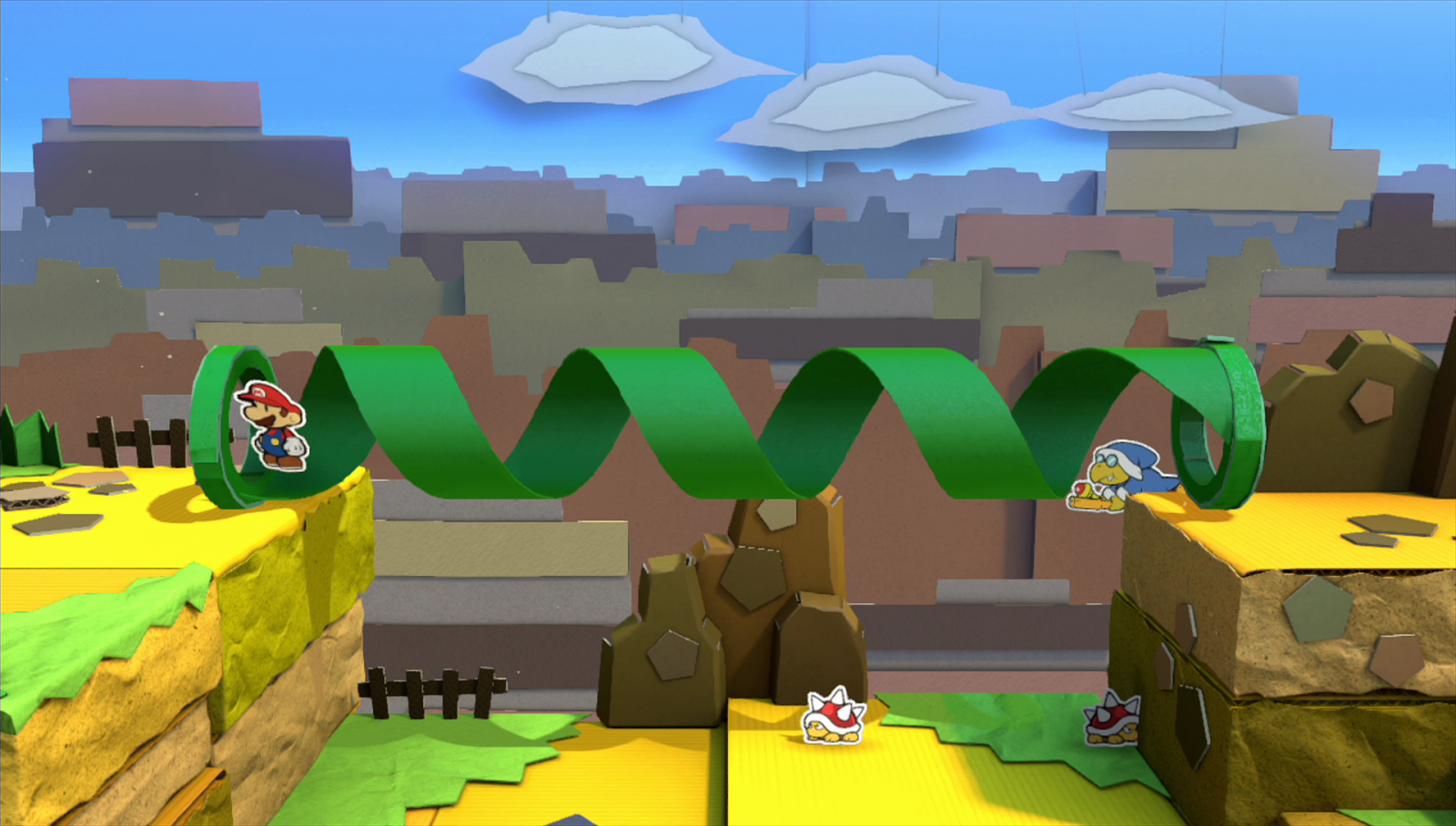
Compared to the first two Paper Mario games, Color Splash's focus lies more in overworld exploration and puzzle solving, than in strategic RPG-style battling (more on battles later). Each of the game's many areas is accessed via an expansive map screen, and new areas are revealed and linked together on the map whenever you acquire a mini Paint Star. Sometimes getting these Paint Stars is as easy as getting to the end of the level as you would in a typical 2D Mario game, but usually you'll need to solve puzzles, talk to NPCs, and battle enemies along the way. You'll have to use all of the moves at your disposal to progress... but unfortunately, there aren't actually that many moves at your disposal.
Click to enlarge
Mario can jump, hammer, paint with his hammer, and cut out chunks of the background on the GamePad in specific locations. Jumping and hammering are exactly what you'd expect, though there is one variation thanks to "Unfurl Blocks" which, when hammered, start a countdown during which you have to find and hit a marked object to make it unfold into some useful structure. Painting with the hammer can be used to fill in the many colorless spots to reveal coins and extra cards (for battling and/or collecting), and to restore the function of an object (for example, coloring a pipe to make it work or a box to make it destructible - these are usually the only objects you're actually required to paint). For completionists, each level tracks the percentage of colorless spots you've filled in; get 100% on a level, and you'll be rewarded with some music in the museum back in Port Prisma. Mario's final ability is cutting stuff out. At certain points, the edges of objects and terrain will shift in perspective to make perfect lines, or there may be card-shaped boxes in the background. In these cases, pressing the Y button will reveal a dotted line which matches up with the suspicious spots and transfers the view to the GamePad where you can trace along the line to temporarily cut out that chunk of the scene. Doing so can allow you to place "Thing" cards to solve puzzles or to walk on top of the background to traverse otherwise impossible gaps or climb to unreachable heights.
Cut out a chunk of the screen, make stairs.
Unfortunately though, these are all of Mario's abilities for the entire game (though there are a couple level specific gameplay variations, such as riding a dragon or pirate ship). The overworld gameplay is solid and entertaining, but unlike previous games in the series which rewarded Mario with at least one new ability per chapter in the form of a partner or new equipment, in Color Splash, you'll pretty much see all of the gameplay the game has to offer in the first couple hours. The rest of the game, while well designed, merely uses the same simple abilities in different variations. Arguably, this is the game's greatest flaw; you'll master Mario's handful of skills almost immediately and for the rest of the game, nothing new is added to keep the gameplay fresh. Everything is still beautifully colored, filled with fantastic music, artistically built with the paper aesthetic, and designed with some decent puzzles and level design, but by the end of the game it all starts to feel a bit stale, like the same old things over and over, just with a new coat of... uh... paint.
Well, it's later in the game now and we're still painting pipes to activate them.
Before moving on to explaining how the battle system works, there are a couple other things worth mentioning about the overworld puzzles in Color Splash. The first of which is "Things". These are rarer, three-dimensional objects which you can squeeze the color from and turn into cards for later use. They'll act as cinematic special attacks in battle (and major bosses typically require a specific Thing card to beat) and they can be placed in certain places outside of battle to solve puzzles (using a fan to blow a ship's sails, for example). Unfortunately, placing a Thing card uses it up, so if you make a mistake, you'll have to backtrack to find another. Fortunately, the puzzles which use Things are far more obvious than they were in Sticker Star, Things you've found in the past can be easily bought in Port Prisma, and better yet, there's a Toad nearby the Thing shop who will give very clear hints as to which Things you'll be needing next and which level you can find them in if you missed them somehow.
Click to find hot grills in your area!
The other thing to mention is that progressing the story in one area sometimes has an effect in another area (for example, a train moving from one level to the next). The most notable recurring form of this is the Toad Rescue Squads, each of which are made up of varying numbers of colored Toads who are scattered across each area and who must be found and told to return to their leader in order to make more progress in their leader's area. Finding them all feels like the sort of thing that might be a side quest, but it turns out that it's required in every case. This could have turned into a nightmare of replaying every area over and over to try to find the Toad you missed, but once again there's a helpful Toad in Port Prisma who will tell you how many lost Toads are in which areas, just in case you miss them on your first time through. The main map also has helpful icons to mark unfinished business in each area, including Toad Squad leaders who are waiting for their team. Overall, what could have turned into a backtracking nightmare is generally not a problem thanks to very clear hints and hard to miss essential Things and Toads..

Battles
Click to enlarge (hah, that pun was accidental!)
The combat in Color Splash is fairly unique and different from most RPGs, though very similar to that in Sticker Star. Essentially, every action that Mario can perform in battle is represented as a single use card, and these cards are scattered around everywhere in the world, or can be bought at the shop in Port Prisma. As was the case in every other Mario RPG, each attack has a certain timing-based press of the A button which determines the damage output. Damage output is also determined by the card itself (a large hammer vs. a broken hammer) and by how much paint is applied to the card. You can tell how much damage you've dealt, not by numbered hit points, but by seeing how much paint you've drained from the enemy's body. Many cards come fully colored, but others are blank and are far more effective when colored in with Mario's paint supply. Paint is limited, but defeated enemies drop more, as does hitting environmental objects with your hammer, so running out of paint is rarely an issue. Running out of cards, however, can be an issue if you decide to fight every enemy in your path. But Color Splash is not a game that encourages level grinding; the only useful things that defeated enemies drop are hammer tokens which gradually level up your max paint. Since there's little reward for fighting unnecessary enemies, it's more accurate to look at them as environmental hazards which are there to be dodged in order to not waste resources which would be better spent on mandatory battles. You may be tempted to run from unnecessary battles to save cards, but this is a gamble between wasting health and wasting cards, since the success rate for escape is random. It's better to avoid optional fights in the first place - or, later, to hit weaker enemies with a preemptive strike to defeat them in one hit and skip the fight entirely. Though if you do run out of cards, you can either try to escape or pay ten or more coins to get a single extra card per turn.
There are several categories of cards which each have many variations and stronger versions that can be found more commonly as the game progresses. The card categories basically come down to: hammers, jumps, fire/ice flowers, restoration items, enemy cards, Thing cards, and a few miscellaneous cards like POW blocks and defensive abilities. Regardless of the specific variation of card in each of these categories, the timing is basically the same. For example, one jump might hit three times, another might hit more, and another may hit all enemies in a line, but the timing for each is the same. You'll find something from each card category pretty early on, so once again, even though its appearance may vary, the battle gameplay remains largely unchanged throughout the game, once again causing it to grow stale by the end. Compare this to other games in the series which kept battles fresh by adding special moves after each chapter and new partner characters who each had different kinds of attacks, and you can see how important adding new fresh variations on gameplay throughout the game can be. (I should note, however, that enemy cards are pretty unique, and can summon an enemy to your aid which stays with you until it falls in battle, somewhat reminiscent of the partners in earlier games.)

While Mario's battle actions don't vary much over the course of the game, the enemies you'll encounter do vary a fair bit, and are pretty much the only things that keep the battles from becoming a mindless grind. Some enemies come in stacks and are better dealt with by using many weak hits, other enemies have spikes, making jumps ineffective, still others can be flipped over, or have other weaknesses. Since Mario always attacks each enemy in the order that they're lined up, there's a bit of strategy involved in choosing the order of your action cards according to enemy weaknesses and your own ability so that the appropriate card is used on the appropriate enemy. Another thing that keeps the battles at least somewhat fresh, is the seemingly random appearance of Kamek, who will block you from running from the battle and curse you with some kind of gimmick like limiting your cards or flipping them all over.
Things come with their own humorous animations when used in battle too.
Boss battles were a bit odd in Sticker Star because they were essentially impossible without using the correct Thing. Well, that's back, but only for a handful of battles, and, once again, the Toad in Port Prisma will tell you which Thing you'll be needing ahead of time. The issue then comes with knowing when in the battle to use that Thing card. It's usually obvious and follows the same format in each boss, with a normal battle segment followed by a Thing segment, but if you do use your Thing at the wrong time, it'll be wasted and you'll have no choice but to run from the battle to get another one or reset the game. Furthermore, there are "Replica" Thing cards which can only be used in battles and not for solving puzzles, but for some reason have no effect on bosses even if they're the correct Thing. So that's not very intuitive.
Click to enlarge
The enemy variety helps to keep the battles at least somewhat fresh.
Also, just a couple minor, miscellaneous things to mention:
There are a few control options to enable buttons to be usable in battle rather than touch controls, though I'm not sure why they aren't just both enabled by default.
Secondly, cards are kept in one long line, simulating how Mario holds them like playing cards while deciding his next move. Cards can be manually re-ordered, or instantly sorted by type with the press of a button. It's a minor complaint, but card organization could have been better with the addition of different sorting options and if cards were displayed in multiple rows so that you didn't have to scroll through as many as 99 cards to get to the Thing object you want at the bottom of the stack.

Miscellaneous Other Stuff
The world of Paper Mario: Color Splash is surprisingly big, and there's a lot to find and do, but almost everything there is to find and do ends up being a required part of the main story at some point. However, there are a few optional goals for the player to pursue.
Click to enlarge
Firstly, there's a museum in Port Prisma that you can donate cards to in order to unlock some pretty spiffy concept art. The museum also contains a sound test room where you can listen to music from each area, which is unlocked for filling in 100% of that area's colorless spots.

Secondly, there are Roshambo Temples, where you compete in a series of three Rock-Paper-Scissors battles, using clues and a bit of luck to win tons of easy coins and exclusive cards.

Third, there are some hidden cut-out spots with secrets in them which award coins, though finding each of them is tracked.

And finally, the main plaza of Port Prisma has some flags with achievement goals written on them. Fulfilling these requirements will unfurl the banners and... seemingly have no effect beyond that (but I haven't gotten them all, so I can't say for sure).

...And that's pretty much every optional side quest in the game. It's not much, but it does mean that the main quest feels extra long thanks to everything else being required.

By the way, for those who want to play on the Gamepad only, yes, you can do that and it works just fine.

The Final Word
Paper Mario: Color Splash is arguably the most visually and musically beautiful game in the series so far. Its main plot may be thinner than usual, but the characters and their smaller, individual stories are put together with hilarious, top notch writing and animation that goes above and beyond the call of duty, giving Toads more personality than ever. I found both overworld and in-battle gameplay to be enjoyable as well, albeit a bit simplistic. However, although everything is great from the start, both the plot and gameplay introduce almost no new innovations for the entire rest of the game, causing it to get a bit stale by the end of the 25 hour adventure. You could say that Color Splash shows its entire hand to the player too early, and that the game's hand consists of only a few very colorful cards. But, complaints aside, Paper Mario: Color Splash is still a rather good game overall, is worth playing, and is something that I think fans of the series and new players alike will enjoy.

Saturday, August 13, 2016

Who likes grinding in RPGs? [Survey Results]

I like RPGs. My friend also likes RPGs. But the other day we got to talking about the common practice of level grinding in the genre, something which I considered to be a tiresome chore, poor game design, and something that potentially robbed a game of its fun by decreasing its difficulty and the amount of strategy required. My friend, on the other hand, disagreed and said that he actually enjoys level grinding; and he's not the only friend of mine who does. In fact, it seems that among my friends, I'm in the minority in my hatred of grinding.

And so, to settle the debate, I asked the people internet about their play styles, specifically in regards to optional level grinding in offline, single-player RPGs. To make sure everyone was on the same page, I (and Wikipedia) defined "level grinding" as "engaging in repetitive tasks (e.g. fighting enemies repeatedly) in order to increase the strength of the player's character or party members".

It's also worth noting that the vast majority of responses were given by users from the /r/SampleSize Reddit community who I asked only to participate if they had completed at least one RPG.

Here are the results:
No, I'm not trying to be deceptive by splitting the "Yes" answers into two categories. I trust my readers to be able to add and see that 61.4% of people do in fact go out of their way to level grind. What is with you people? ...Well, I asked that too:

Respondents who admitted to preferred grinding were allowed to select as many of these generously understanding reasons which I supplied and even write in their own. In retrospect, perhaps I should not have included the "I want to see optional content that can only be reached at a high level" option because it arguably goes against the original stipulation of this being about grinding when the game doesn't require it. But since it was possible to select multiple answers, there was no harm done. A couple of the "Other" answers include wanting to get one's money's worth out of the game, and enjoying optimizing characters in general or using naturally weaker characters that would be unusable without some grinding. One person wrote in "sometimes it's necessary", willfully defying my "when the game doesn't require it" clause.

As for my brethren, the non-grinders, they were also asked for their reasons in the same way:
I don't think these results are too surprising. Almost everyone who doesn't grind thinks it's boring and around 40% don't have the time to put into it. Most of the "Other" submissions on this one came down to players not finding it necessary to level grind because their completionist play styles, which often included doing side-quests, resulting in them getting plenty of experience already. One person wrote in "don't want to waste time", because presumably they have the time and just think it would be better spent on something else.

And, well, that's that.

If you'd like to see all the raw data for yourself, here it is. (Note that additional responses may be recorded after the date of this posting and these were not referenced above, obviously.)

If you'd like to take the survey, you can do it here, though I won't be updating this post with future results.

Friday, July 1, 2016

E3 2016 Impressions - Additional Game Coverage

I've already organized my impressions into my favorites, indie games, toys to life, and VR, which left me with a handful of others that didn't fit into any particular group. And so, here is my final E3 2016 coverage article, with no organization at all.

ReCore (XB1, PC)
After Zelda, ReCore was my second favorite game that I tried at E3 this year. It's a blast to play in every way. The presentation is full of color and full of action - explosions are everywhere, the main character looks awesome, and enemies are unique and color-coded based on their weakness. The controls are wonderfully smooth, even while being complex enough for an experienced gamer. While running around, double jumping, gliding, and dodging, you also have to manage targeting and shooting enemies, which can be done with bursts of shots, charge shots, special attacks from your partner, and constant quick switching of your gun color to match the enemy's color. I loved how fast-paced ReCore was and how nicely it combined platforming and shooting. And it was actually fairly challenging as well; it was nearly impossible to actually finish the demo on your first try. According to the demo attendant, ReCore is a story driven game of sequential levels rather than another open world exploration game like so many games on the market these days.

This is definitely a game to pay attention to. It felt like a 3D interpretation of a crazy SNES run-and-gun game mixed with Metroid Prime with better controls, and I loved it.

Final Fantasy XV (PS4, XB1)
Anyone following this game probably already knows more about it than I do. ...But I did play the demo. It mostly felt like a battle tutorial, with a few simple enemies to beat up in a linear canyon, and then a boss battle against an enormous giant. I barely had a feel for all the controls by the end of the demo, but basically, you use magic, switch between melee weapons while you wait for others to regain their power, guard, and fly through the air to hang onto terrain with your weapon. The boss fight developed slightly over the course of the demo with a few different mission objectives which mostly just told you to guard and counter the giant's huge hands that would try to crush you, or to run away, or to attack while flying through the air, or finally to attack with Blizzara and finish it off. Even though the demo mostly just amounted to following a series of on-screen instructions, it still felt pretty epic.

One random thing I took note of and which I was impressed by was how using Blizzara would actually make the nearby terrain look frozen and cover your characters in frost. At one point, I used Blizzara before a cutscene by chance and was pleased to see that my characters remained covered in frost even during the cutscene. Neat.

Bound (PS4)
(Official Trailer)
It remains to be seen how fun Bound will actually be, since the demo pretty much just consisted of very simple 3D platforming and wall jumping. However, while the gameplay was nothing special, the super creative and mesmerizing art style blew me away. I keep thinking that I've seen everything when it comes to stylish and unique art in games, but once again I was shown something new and different in Bound. The world is built out of paper-like walls that fold and unfold as you approach them, ladders with rungs that spin oddly into position, polygons flipping into existence under your feet, and distant views of waves of oscillating cubes. It's bizarre, but it's a visual delight, and I'm curious to play more if only to see what crazy abstract 3D art they came up with next.

Steep (PS4, XB1, PC)
Remember SSX Blur on Wii? ...yeah, I didn't think so. But Steep is a whole lot like it; you pick a spot on one of a few perfect snowboarding/skiing mountains and then go. Or you can use a glide suit and parachute. Anyway, as you go down the mountain, you can simply screw around and have fun or you can find one of many challenges, usually races or score attacks. Races are straightforward, but I found score attacks to be particularly interesting because they weren't simply about doing tricks (the only tricks I learned to do were rotations and grabs anyway), but you'd also get points in the style of Burnout or Excite Truck for nearly missing trees or gliding dangerously close to the ground. Also, there's multiplayer, but you can't collide with the other player it seems, so it's more just simultaneously competing in the same challenge for a higher score or faster time with a live opponent. Steep was fun and satisfying, and there were challenges with fairly high difficulty, but unless there are more movement options and tricks that I wasn't informed of, I could see it getting old after not too long. It felt more like a good $20-$30 game to me than the $60 they'll probably be asking for on release.

Gravity Rush 2 (PS4)
I never did get around to playing the original Gravity Rush, but it always looked like fun. Unfortunately, since I don't know much about the original, it's hard for me to tell what is new and different in Gravity Rush 2. You still switch the position of gravity for yourself and basically fly all over the place and kick enemies out of the air. The controls certainly took some getting used to for me and this was perhaps the only game for which that was the case, but the main reason for that was simply not bothering to set my preferred camera invert settings. Don't get the wrong idea and think that I'm complaining about the controls though; I'm sure they can be learned in no time and that it's very satisfying to fly around when you have the hang of it.

This was also the second of three games where I encountered a major glitch preventing me from progressing (a soft lock), but it appeared that the glitch was likely due to having abilities in the demo which wouldn't have been available at this point in the final release. It happened because, at the demo attendant's suggestion, I did some kind of transformation coincidentally right into a cutscene trigger, causing my character to stand and wait for a cutscene that never came. It was kind of a bummer, but I wouldn't worry about it happening in the final product.

Hatsune Miku: Project Diva X (PS4, Vita)
(Japanese version gameplay, not from the English E3 demo)
I needed to play two Atlus demos to get a free hat, and Project Diva X was the first one I saw. I'm a decently big fan of Project Diva f 2nd, so I was already familiar with the gameplay, which hasn't changed much in X. The game has already been out in Japan for a while, so you probably don't need me to tell you much about it. The menu and song/item unlocking system seems different, though I don't know the details. I do know that songs are divided into categories like "Cute" and "Cool" now. Also, the gameplay now has "Rush" icons which require you to mash the corresponding button. And the score calculation might be different now, judging from the percentage thing in the bottom left. Whatever. You probably already know more than I do. I just like pushing buttons to overly happy Japanese music.

Kingdom Hearts II.8 Final Chapter Prologue (PS4)
It's not Kingdom Hearts 3, but it has some new content in the form of two new stories, in addition to an HD version of Dream Drop Distance. It plays like a typical Kingdom Hearts game. What did you expect? The Dream Drop Distance remaster looks pretty nice, but isn't mindblowing since it's just a remaster. The original content, on the other hand, is very very pretty. The fractured world shown in the video above had lots of detail and every attack had a rain of particle effects that flew off. Admittedly, I'm not a huge fan of the series, but this seemed good enough to help tide over fans for yet another unknown length of time until the next KH3 announcement and eventual release.

Star Ocean: Integrity and Faithlessness (PS4, PS3)
(Official Gameplay Trailer)
It's hard to get a feel for an RPG from a demo, but the feel I got from the new Star Ocean is that it's pretty, but has fairly mindless and repetitive combat. I just explored a nice looking outdoor dungeon and fought a bunch of enemies by mostly mashing a couple attack buttons and moving out of the way of their attacks when possible. I didn't dislike it, but it didn't feel like anything special either. Still, with just a demo, I can't say for sure how the combat might develop over the course of the game or whether there's a good enough story to keep the player motivated through what could end up as a grind. At least the graphics are fairly pretty though.

Just Cause 3: Mech Land Assault
This is DLC, I guess? I've never played a Just Cause game, but I've seen some neat gifs on Reddit. My experience was basically those gifs: hopping into vehicles and driving them into other vehicles or off cliffs to watch the explosions, and grappling onto everything (like a windmill!). And also throwing grenades and everything. So, uh, no idea what the Mech Land Assault DLC adds (I didn't see any mechs, but I did see land), but I get the feeling that I've been missing out on Just Cause 3 in general. I couldn't wipe the grin off my face every time I succeeded (or failed) in an attempted epic maneuver.

LEGO Worlds (PC)
LEGO Worlds is already available in Early Access on Steam (which I would never recommend), but for just jumping on this demo because it had no line, I actually enjoyed it a good deal. It looks like a Minecraft clone at a glance, but it's more of a Lego-building sandbox of pre-built terrain, structures, and NPCs that you can screw around with and mold to your liking. (I realize that still sounds exactly like Minecraft, but it's different, I swear!) There are a surprising number of options for quick terrain editing (adding or deleting large cubes, sphere, etc.) and laying down bricks of all shapes and sizes. You can play as lots of different Lego characters, which tend to have cute unique animations (like a werewolf running on all fours) and attacks (like a guy that attacked with a camera or bagpipes).
After I sat down for the demo, two others soon joined me on my right and left. On my right, the guy had quickly spawned armies of werewolves and cavemen which he was going to pit against each other. On my left, someone else had spawned a digging machine with giant drills on it and was plowing through the terrain and even making an "impossible" shelf of water out of the ocean's edge. Meanwhile, I was playing with a grappling hook and flinging myself from tree to tree, until I encountered a glitch which got me stuck in an infinite jump, but hey, early access. Anyway, LEGO Worlds seems a tad rough around the edges at the moment, but I had a lot of fun with it, so it may be worth checking out when the final version is released.
Additional E3 2016 Coverage

Friday, June 24, 2016

E3 2016 - What They Call Games' Top Pick

Disclaimer: I received a free 3-day pass to E3 from Nintendo, but my opinions written here are still my own.
The Legend of Zelda: Breath of the Wild (Wii U, NX)

There's no reason to beat around the bush (they don't drop rupees or hearts any more anyway) - Zelda: Breath of the Wild was easily my favorite game that I played at E3 this year. It's a bit hard to write about it because so much more was already shown off during the Nintendo Treehouse stream. Even with the generous 25 minutes of gameplay split between two demos that I got to play, there was so much that I didn't see and which already has been revealed to the internet by Nintendo and others who have played the demos. But, nonetheless, here are my impressions and perhaps there will be something new for you.

My E3 Zelda experience backstory:
So, for a bit of context, while waiting for the doors to open to the E3 show floor, I was able to catch the new trailer for Zelda as it was streamed, and just a bit of additional gameplay from between the obscuring heads of the crowd. I've actually avoided watching further gameplay and coverage to keep spoilers for myself to a minimum - probably not the best move for a blogger, but I'm sure some readers would also prefer to be mostly unspoiled as well.
After a long, but worthwhile wait, full of things you couldn't possibly want to hear about (meeting Charles Martinet, interviewing the translator of Zero Time Dilemma, etc.), I entered Nintendo's E3 area, checked out the upcoming amiibo, and was seated in a small room that was decked out to look like a dungeon from Breath of the Wild (shown above). There, we were introduced to the game with a brief gameplay trailer which showed many of the things that could be done in the game. We may have just been giddy about finally getting to play, but the trailer elicited a laugh from the audience on more than one occasion when Link did silly things; most memorably his soup gobbling and under-equipped shivering animations which I can only describe as adorable. The gameplay trailer ended with an animation of the wall rising up like an ancient, magical, dungeon doorway to reveal that the wall it was projected on had actually risen in real life as well, allowing us a path into the large and impressively decorated demo area.
(Additional demo area photos on the What They Call Games Facebook page)
Demo Impressions (10 Minute Exploration Demo + 15 Minute Story Demo):
Clearly, since this was my top pick, I thought it was extremely fun to say the least. The biggest reason for that was the huge variety of different gameplay mechanics and options available in combat and exploration. You've more than likely already seen what I saw in the trailer and streamed gameplay, but I had a blast with simply defeating enemies with each new kind of weapon I discovered: a sword, a stick, a spear, an axe, bombs of multiple kinds, the bow, and my proudest discovery, a fire rod. The fighting controls were gloriously responsive and smooth (the speed at which you can swap equipment also comes to mind as a highlight), and I quickly felt right at home with the combination of gameplay from classic 3D Zelda games (side hops, targeting, backflips, etc.) and the new additions in Breath of the Wild. I particularly enjoyed setting fires and watching it spread with the wind, as well as making apparently difficult head shots with the bow with relative ease thanks to the GamePad's motion controls. And then there are the environmental kills from pushing boulders or cutting down trees. For exploration you have gliding, using trees to make bridges, swimming, tons of different items to collect (though I wonder if some might be the sort of thing you come to ignore quickly), equipment that helps with particular environments, lots of cooking recipes, and, of course, climbing on everything. (I didn't actually try all of those things during my demo, by the way.) I can't wait to see all the new options even beyond those that will become available with the new items that are surely hidden later in the game.

Although the weapons degrade and eventually break, their variety in stats and type gave me the idea that challenge runs would be fun in this game (i.e. beat the game only with sticks, spears, etc.). I also found that sitting at a campfire could be used to change the time of day in-game, so I wouldn't be surprised if different things became available at different times.
I found a fire rod!
One of my biggest fears for the game when hearing rumors of it being more open world was that it would be an empty world with little to do, but my concerns were quickly alleviated. There are plenty of items to find, things to fight, and places to discover that are worth the journey just for the view alone (although they do tend to hide treasures as well).
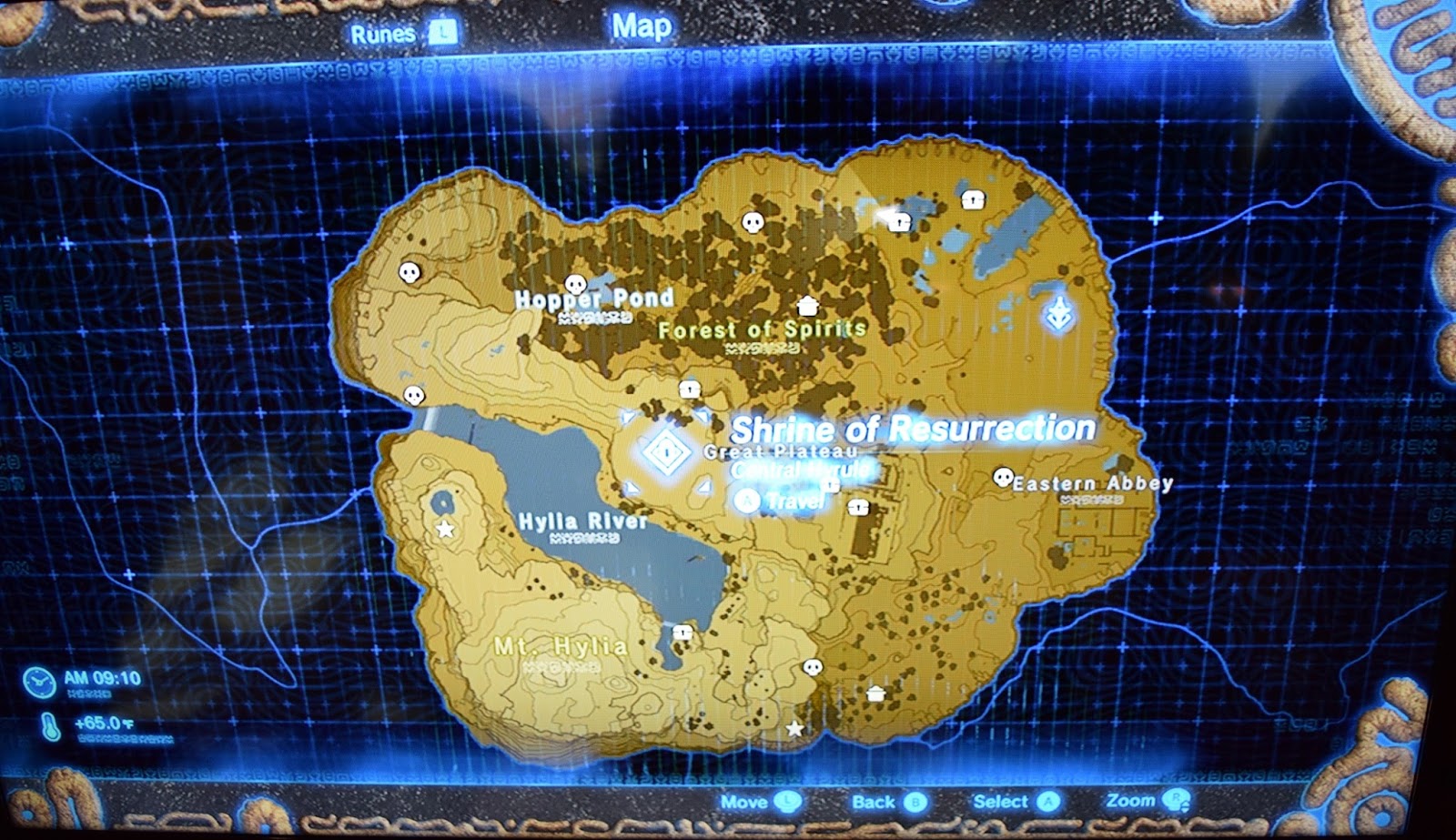
The area available in the demo is only a small part of the game's world.
(Click to enlarge)
And, ah, what views there are. I've enjoyed games primarily for their artistic, eye-pleasing scenery on many occasions (for example, in Journey, Xenoblade Chronicles, Abzu, and Shadow of the Colossus) and been equally bored by worlds of muddy-colored, "normal" designs. Certainly, one's enjoyment of art will largely come down to personal taste, but I could tell that, personally, Breath of the Wild's art direction would be right up my alley. It's bright and colorful, enormous in scale, lonely (but peaceful) in mood, and filled with fantastic terrain and structures. There are story-related goals in the game, as I was shown in my second demo, but even if there were no goals at all, I would be fully entertained in simply exploring and taking screenshots of the beautiful world, as if inside an interactive painting. And, as I said before, the animations are equally stylish and often add bits of humor to the adventure. The visual art can't be talked about without also mentioning the audio... except, I honestly didn't notice the audio enough to say much about it. From what I recall, mellow mood-setting music faded in and out while exploring, which is certainly a change from the Zelda series' usual melodic earworms, but it did succeed in setting the mood and not being annoying with repetitiveness.
I discovered a familiar statue from Skyward Sword.
Also in this area, I found a bow with no arrows, while the person next to me found arrows with no bow somewhere else.
As for the story, I can't claim to know a whole lot. Link wakes up in the mysterious Shrine of Resurrection, which seems to have magical technology that's more futuristic (or ancient) than usual. As Link, the player quickly makes their way out with the occasional guidance from a GamePad-like item, the Sheikah Slate. If the final game is like the demo, this opening tutorial is quite short and upon exiting the shrine, you'll have immediate freedom to explore or pursue the next plot points by talking to a nearby old man and traveling to a distant location marked on the map. For the extra impatient, the cutscenes were even skippable. Since I figured everyone would be following the story on the "story demo", I just continued playing around and going in other directions for the entire time I played. It's great to feel in control of your own gameplay choices for once, rather than being pushed through a series of story hoops before finally being allowed to explore.

Finally, since I am a critic, I have to criticize just a little bit. Actually, since the game isn't out yet, this is the best time to make suggestions, when there's still time for things to change. (Being able to make suggestions to developers and demo attendants who seemed to actually care and take note, was one of the coolest things about playing games at E3, though I rarely had any complaints to make - usually just questions.) With Zelda, there were really only two small issues that I noticed: the frame rate and the movement controls in certain situations. Frame rate complaints are pretty self-explanatory; Breath of the Wild did not run at a steady frame rate, which did unfortunately detract from its visual appeal a bit. Considering how long it's been in development, I doubt this is something that can or will be fixed before launch, but I wouldn't doubt that a steadier frame rate will be one benefit of the NX version over the Wii U version. Most casual players don't even seem to notice frame rates though, so I suppose this isn't a huge deal for most.
The default (only?) controls in Zelda: Breath of the Wild
The somewhat bigger deal is that the demo did not have re-mappable controls, something which should be standard in every game. I said earlier that the controls for combat and equipment switching were fluid and fantastic, and this is true, however general movement controls leave something to be desired as a side effect of having so many actions mapped to so many buttons. Here's the problem: you can't run and jump (and move the camera) simultaneously without awkwardly putting a second finger up on the face buttons to press two at once. In most cases, you won't need to do this, but there will be times that you will, and it would be incredibly helpful for there to be an option to remap buttons to one's personal preference. This was just a demo though, so it's entirely possible that these kind of control options are already in the full game (the attendant I asked didn't know, but said that I wasn't the first to ask).
Screenshot via Nintendo.com
The Final Word:
All things considered, my gripes about the frame rate and control options are minor compared to how fun and beautiful this new Zelda seems overall. Whether or not you will enjoy this return to the series' open world roots will be up to personal taste, but it certainly has me excited. I rarely get hyped over new games these days when I already have so many great old games to play, but Breath of the Wild is a rare exception that has me genuinely excited to try more as soon as I can. There's so much to explore and so much to do while exploring and I can't wait to do it all.


Additional E3 2016 Coverage
Related Posts Plugin for WordPress, Blogger...