Showing posts with label nes. Show all posts

Friday, June 20, 2014

FTW: TheMexicanRunner attempts to beat every NES game!

This very well could be the most interesting to happen on Twitch since TwitchPlaysPokemon - especially if you didn't like TPP. TheMexicanRunner, known for having held and currently holding world records in speedrunning Battletoads, Contra, and several other games, has now embarked on an even more epic quest: beating every winnable NES game licensed in the US. That's 709 games!! As of now, he's finished 28, including classics like Super Mario Bros., The Legend of Zelda, Metroid, Metal Gear, and, the most time-consuming of all (so far), Ultima III. It's not all classics though; he's also conquered the infamous Silver Surfer and the cult hit, Monster Party, and has The Trolls in Crazyland as an upcoming game. Each game is selected by a viewer chosen by a raffle at the end of each game, so you could even get to pick his next game.

For an ordinary human, this might be an impossible task, but this is the guy who speedruns Battletoads and beats Ninja Gaiden without breaking a sweat. I can't guarantee that he'll actually accomplish this challenge, but he's still going strong so far and excelling at every genre of classic Nintendo games.

If that sounds up your alley, check him out on his Twitch channel and follow him on Twitter to find out when he'll be streaming next (almost daily). And here's an updated list of the games he's beaten and what he has left.

Update: NESMania now has its own website! Check it out!
Update: Check out the YouTube channel to watch games you missed!

Monday, March 10, 2014

Spot - The 7 Up NES Game

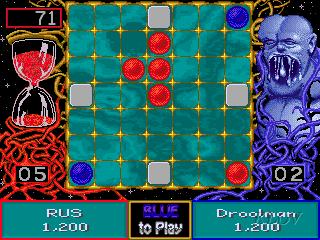
Sometimes the cool and refreshing taste of 7 Up® just isn't enough. Sometimes you need a 7 Up® themed video board game to go with your delicious lemon-lime beverage. Luckily for you, there is Spot: The Video Game, a multiplayer strategy board game available on Amiga, Atari ST, DOS, Game Boy, and NES featuring the red spot from the 7 Up® logo. This review will focus on the NES version.
The game works similar to Reversi and identically to the arcade game Ataxx. Two to four players, with any combination of humans and computer controlled players, battle over a grid which measures the perfect number of soda ingredients (seven) both up and across. The goal is to have the most tiles of your own color when the grid is filled or to completely eliminate the other players' tiles. Players can select a space adjacent to one of their occupied spaces to copy their color onto that space or they can skip a space and move their tile without copying it. Any opponent-owned tiles that your newly moved piece touches become yours. That's it; simple, yet complex, just like a cool glass of 7 Up®. (By the way, there's also a hidden space that gives the person who first activates it a shot at stopping a slot machine and winning a free turn, but that's pretty insignificant in the long run.)
There can be a lot of thought and strategy involved in playing this game, so if you're taking it seriously, one game could go for a good half hour or more. But if you're playing with your mom and she takes forever to decide on a move, you can actually set a turn timer for each player individually to force them to make a move or else forfeit their turn. The difficulty of computer players can be changed as well. If those options weren't enough, you're also able to design your own board by enabling and disabling spaces beforehand or by choosing from one of many preset designs, in the same way as you can choose from any of the delicious and/or low calorie varieties of 7 Up® soda.
After 20ish years, I once again played Spot with my dad.

Spot: The Video Game replaces the rather macabre scifi theme of Ataxx with its own hip (and family friendly) Spot character who stands on the side snapping his fingers to the music while he waits for you to make your move. There is also a fluid and unique animation and short musical ditty which accompanies each of the possible moves you could take. Apart from the short bits of music that go with the move animations, Spot has one main theme and it's not half bad. However, unlike taste of Cherry 7 Up®, the music does get old after a while.

At the end of the game, the winner is treated with a fireworks show and an animated crowd holding up signs to say "BLUE (or whoever) WINS". It's almost, but not quite, as entertaining as winning Windows Solitaire.

The Final Word
Unlike Itadaki Street / Fortune Street, which expanded on physical board games to a level that could only be achieved with a video game, Spot: The Video Game is simple enough that it could be played as an actual board game without too much effort. That said, there is a fair bit of strategic depth to this easy-to-learn game. If you're a fan of playing board games on your TV, grab a 7 Up® and give Spot a try.


This is part of a series on forgotten games from my childhood. Previous: Super Solvers

Tuesday, December 24, 2013

I found baby Jesus! - Merry Christmas

There's no better way to celebrate Christmas than to play the notoriously bad unlicensed NES game by Wisdom Tree, King of Kings. It's got three games in one and they're all piles of reindeer poop. All I cared about for now though was the first game, "The Wise Men". In it, you play as a wise man riding on a rock-spitting camel who is following the star to find baby Jesus. From there, it's just simple platforming with horribly slippery physics.
I traversed the desert and collected scrolls for health, along with frankincense, myrrh, and gold for completely useless bonus points.
Scrolls could only be collected by answering Bible trivia questions which were often reused. Even though the health apparently maxed out at five, you could continue collecting more than that and it would just not be shown on-screen.
Orangutans seem to work for Satan
The fifteen stages varied wildly between stupidly hard, stupidly easy, and just plain stupid. Much of the platforming was unexpectedly hard, and falling would often make you to start all over. One level required you to re-enter a door that you just came out of in order to get to a new area. It was dumb.
There were also sharks in the waterfalls. Better than a sharknado I guess.

At last, I reached baby Jesus. 
Along with this screen, my reward was an 8-bit rendition of Away in a Manger, which I guess was better than the 8-bit version of We Three Kings that played for the entire rest of the game.
There weren't any credits, but there was this final screen instead. Regrettably, I don't have the beginning or the end of the manual, so you'll have to keep wondering about that.

Now that baby Jesus has been found, you may resume having your merry Christmas and happy new year.


Also check out my pitches for 7 Bible-based games that'd be totally righteous.

Monday, August 5, 2013

Felix the Cat is a bag of tricks

Platform: NES    Genre: Platforming   Release: October 1992
If you're looking for a platforming game for NES, you shouldn't have any trouble finding one. If, however, your search is more specific, say, for a good platforming game for NES based on a cartoon character which isn't "Nintendo hard" to beat and isn't just a Mario clone, look no further! Felix the Cat is the game for you!

It was released in 1992, which is pretty late for an NES game. As such, it has nicer graphics and more variety in gameplay than some of the earlier games on the console. Also, it's by Hudson Soft, so that's always a good sign.

At a glance, it looks the same as any other platforming game, but there are a few things that set it apart. For one, you can't kill enemies by jumping on their heads - in fact, it hurts you to do so (except birds, which you can ride). Instead, you'll be pressing B to use your attack. This starts out as a boxing glove that pops out in front of you, but can be powered up to magical sparkles that attack in all directions, a plane that shoots, and a tank that lobs bouncing balls. Strangely enough, Felix's second form is actually the easiest to attack with in most cases, but remaining in this form means having less hit points.
I'm a tank!
These transformations and upgrades are the main way that this game distinguishes itself from the others. Rather than searching for specific items to power up, a power up item will drop for every ten Felix heads you collect. (Collecting power ups when fully upgraded results in a 1-Up.) These are essentially the same as coins in Mario and are strew about each level, but now they actually serve a purpose. Getting hit while powered up will revert you to your previous form. As you'd expect, getting hit in your base form results in a death. But there's another way to revert to lower forms: by running out of time. Each powered up state has a timer, which will power you down if you let it run out. This is almost never a problem, however, because it gives you plenty of time and because for every five Felix heads you collect, milk (or another upgrade) will drop, which can be used to refill the timer.


Felix is smiling because his plane just pooted.
The game isn't just limited to land based stages; there are also flying levels, underwater levels, boating levels, and even an outer space leve, each with its own unique transformations for Felix. These offer a nice break and keep the game from getting boring. If I had one complaint, it would be that the player's greater freedom of movement in the flying levels caused the level design to suffer. They kind of feel like a lot of empty space with enemies and cannons just laying around. It's not that big of a deal though, since you'll probably be having so much fun being an airplane that you won't even notice.
Pogo Sticks:
Easier to animate than legs since always.
Each of the nine worlds (except for World 8, which is only one level) also has a boss at the end. They aren't all that difficult, but it's nice that they're there. Mostly they just move around and shoot at you occasionally until one of you dies. In between some worlds, there are even cutscenes, which consist of the bad guy (who strikingly resembles Dr. Wily) calling Felix to taunt him about having kidnapped his girlfriend. I'm not really sure why the mad scientist wanted to kidnap a cat in the first place or why Felix is back in his house in between levels to answer the phone. In any case, cutscenes are a nice touch.

To match the snazzy graphics, the game's soundtrack is also above average, featuring many tracks that'll be stuck in your head long after you finish playing. Some of the music towards the end of the game actually set the foreboding mood so well that it kinda scared me as a kid. Another minor thing to note in regards to the music is that it gets quieter when you're about to finish a level. It's really an insignificant thing, but it's one of the only instances of dynamic music in an NES game that I can think of.
Imagine Felix's surprise when he found that the mad scientist had infused his girlfriend's DNA with Piglet's.
As for the game's difficulty, it's actually not that bad. Experienced players won't have a very hard time beating it as long as they stock up on a few extra lives during the earlier levels. Even as a kid, this was one of the few games I was able to beat, though it did take me several attempts. Although a game over sends you back to the beginning of the game, Felix the Cat is fairly generous with lives and continues, so you should be alright if you're careful.

The final word:
Felix the Cat stands apart from the crowd of other platforming games thanks to its transformation system and generally well polished gameplay and presentation. It's a bit on the easy side, but that doesn't mean it's boring. We can't all be Ninja Gaiden speedrunners; for the common man, there's Felix the Cat, and it deserves the same remake treatment as Ducktales, or a virtual console release at the very least.


This is part of a series on forgotten games from my childhood. Previous: Home Alone (NES) Next: Super Solvers: Midnight Rescue! and Gizmos & Gadgets!

Monday, July 8, 2013

Home Alone (NES) - The sound of your enjoyment falling down the stairs

Platform: NES   Genre: Hide and Seek?   Release: October, 1991
Home Alone (the movie) is a heartwarming tale of a boy who is forgotten by his parents and then screws with the burglars who break into his house. The video game adaptation for NES is pretty much like that too, since receiving this horrible game could only be a result of your parents not loving you. The screwing with burglars part comes in the game itself.

As a kid, I didn't really catch most of the jokes in the Home Alone movies; all I cared about were the pranks and traps that Kevin set for the Wet Bandits, which were usually elaborate and cringe-tastically brutal. You'd think that a video game that took this most violent and exciting part from the movies would be at least a little bit fun... but it's not. 

Instead of elaborate traps, all you need to do is pick up an object with one button and put it down with another button. Having done so, you will have successfully laid a trap. There's no way of being creative with these traps, as they are all just squares with different icons inside them. Some of the traps that you can put down are recognizable from the movie, but it's hard to tell what others even are or how they would be helpful.
I recognize the tarantula, but what's a light bulb going to do for me?
Actually having Harry and Marv fall into your carefully laid traps is equally unsatisfying. No matter what the trap is, if they touch it, they fall down in a heap and are stunned for a short time. 
That green tank with the three dots above it is Marv after being hit with a tarantula.
The green tank on the right, I mean. The green stuff on the left is bushes.
The game laboriously continues until you are captured or until you survive for twenty minutes. That's right, if you're good, you can finish the whole game in twenty minutes. But not just any twenty minutes, these twenty minutes will be spent running around the same one level, because the entire game takes place in the McCallisters' three story house, its basement, and the tree fort in the yard. Interestingly, the tree fort, basement, and house interior each have their own music tracks, which is better than only one music track I guess.
Here's the map, with Atari-style bars representing each character and trap.
They'll never know!
Apart from laying traps, you're also able to evade capture by hiding in certain background objects. This method is fairly unreliable and you'll probably only use it as a last ditch effort to escape, but it's perhaps the coolest thing to do in the game. Not knowing whether your hiding spot will actually work is kind of like playing Amnesia, except that Amnesia is actually well designed. In Home Alone, you don't really know how long a trap will stun the bad guys, whether or not hiding will work, where the burglars are at any given time, or whether you're standing in just the right spot necessary to climb the stairs. For how meager the content in this game is, you'd think that it would at least be well-polished, but it's really not. In fact, your best bet for winning the game is to find a loop to get the enemy AI stuck in, so you can just do the same thing over and over until the twenty minutes are up.

The final word:
This game is bad. Really bad. It's even worse than it looks in this review. The explorable area is small and the gameplay is unsatisfying and awkward. It probably would have been more fun as a multiplayer game of tag or hide and seek, though I don't know how that would have worked on NES. As it is, even if you do manage to help Kevin protect his home from the burglars, if you paid money for this piece of crap game, you're the one who got robbed.

This is part of a series on forgotten games from my childhood. Previous: Bonkers (Genesis) Next: Felix the Cat (NES)

Monday, January 21, 2013

Let's Play Co-op NES Games

I had an itch that needed to be scratched. It was the co-op NES game itch. So, without telling him what we were going to play, I invited my friend over for some games. Somewhat surprisingly, there were a lot of co-op NES games to choose from, especially among beat 'em ups and shoot 'em ups. I decided to go with two I was familiar with and one that I hadn't really played before. Also, I recorded our experiences for your viewing pleasure. Enjoy!

Chip 'N Dale: Rescue Rangers 2
This game is impressive for its time and still a joy to play today. It's got your usual platforming, but you can also pick up and throw objects like in Super Mario Bros. 2, hide in boxes like in Metal Gear Solid, and ride in minecarts like in Donkey Kong Country. There aren't that many levels, but each level introduces entirely new graphics, music, enemies, and subtle gameplay mechanics which are often used only once. It's really cool to see new things introduced so often and for them to be implemented so well. The settings for each level aren't the usual platforming game levels either; instead of grassy areas, deserts, frozen tundras, and lava levels, you'll run through an oversized restaurant, clock tower, sewer, wild west, and others. Of course, what makes this game even better is the simultaneous co-op, which feels like New Super Mario Bros. Wii, way before that even came out. There are plenty of ways to interact with your partner too: you can jump on them, pick them up and throw them, and even attack them if you wanted to. It's super fun and all of these things together make Chip 'N Dale 2 really feel ahead of its time.

Bubble Bobble
Bubble Bobble isn't exactly bursting with a variety of content like Chip 'N Dale was, but that's alright because it has solid and fun core gameplay and over 100 levels to enjoy it in. And it's also like six years older than Chip 'N Dale 2. In fact, it's a port of an arcade game. In each level, all you have to do is shoot bubbles at the enemies to capture them, then pop the bubbles to kill them. If you don't do it fast enough, they'll get angry and move faster, and if you're still too slow, an invincible enemy (that scared me as a kid) will appear to motivate you further. Apart from the normal bubbles you can shoot, there are also special bubbles that float around certain stages that can drop fire, shoot lightning bolts, or send you shooting down the stage when popped. Once again, playing with a friend makes everything more fun. It's also nice that this game has unlimited continues and passwords for each level that aren't annoyingly long. If you manage to get to the end, there is even a secret ending to go for if you think you're skilled enough. Even though this game is quite old, it's still unique and fun to play.

Contra
Ouch. My friend and I didn't do nearly as well at Contra as we did in the other games. And that's saying something, because we did pretty badly at the other games too. This game is hard, so it's no wonder it made the Konami code famous. It didn't take us long to resort to the free thirty lives the code gave either. Though we still didn't make it far, it definitely seemed like the kind of game that would be really fun to play if you were good at it. The best things about it were its fast pace, the ability to shoot in eight directions, and the plentiful weapon upgrades. Unfortunately for us, if you die, you lose the weapon upgrades, so we were limited to feeling awesome for only seconds at a time. The stages seemed to be divided into side-scrolling platforming stages and third person tunnel stages. The controls for platforming were wonderful and easy to use, but the tunnel levels were a bit less intuitive and had a bit of a learning curve. For us, those levels were less fun and often resulted in deaths due to misunderstanding the controls and graphics. Even though I did pretty badly and would've liked to see more platforming stages, I can't deny that what I saw of Contra seemed to be a great game. But if you're playing it for the first time, don't expect to be a master from the start; this game is Nintendo hard.


That's all for this week, but if you have any recommendations for more co-op NES games you'd like to see us play, let me know in the comments and you could see them in a future post.

Monday, October 15, 2012

Kill Sauron with Bacon in Air Fortress

I found out about Air Fortress earlier this year when I was looking through a list of games made by HAL Laboratory, the developer responsible for Kirby and Super Smash Bros.. It turns out they've been around a lot longer than I thought: since 1980. I tried out Air Fortress along with a few other games and decided that this would be a good one to get and review in greater detail.


Pop bubble, receive bacon.
The game itself can be explained pretty simply. Each level is divided into two parts: a traditional space shooter part and an on foot part. During the space segment, you ride on (not in) a spaceship and approach the air fortress, which really is a space fortress. While doing so, you must shoot enemies and dodge obstacles, like the giant turd-shaped asteroids that appear to be in the background but aren't. But more importantly, you collect bubbles of E and B which will prepare you for the second segment. One's first assumption might be that E stands for Energy and B stands for Bombs, but there's nothing that confirms this. I first assumed that the E stood for Earwax, but later I realized that E and B could only possibly stand for Eggs and Bacon.

Once inside the fortress, you're on foot, armed with a gun, your collected bacon, and a jetpack that runs on eggs. The goal here is to find and destroy the Eye of Sauron which powers the space station, then find the exit before the fortress explodes with you in it. Of course there are enemies to worry about too and as the levels go on, the air fortresses become more and more mazelike.
For Frodo!!

Navigating with the jetpack is pretty cool, and when you shoot it kicks you back realistically. Any movement or shooting decreases your eggs, but standing still makes them quickly recharge. If you get hit by an enemy your maximum number eggs decreases, and if you run out of eggs, you die. The bacon acts as a limited use explosive shot, which explains why so many mistakenly believe that the B stands for bomb.

Every level works pretty much the same way and rapidly gets harder until, when you get to level 5 or 6, it's nearly impossible. I don't see how you'd ever be able to finish them all, but there 8 levels and then second quest versions of each level. Thankfully, there is a password system in this game so you don't have to do it all in one go. Seriously, some of these levels all but require you to map them out so you don't waste all your eggs wandering around and so that you can actually escape when you get to that point.

The music is pretty much the same throughout and has just two main tracks, one for each section, so by the third or fourth level you'll have them hopelessly stuck in your head. The graphics are pretty old looking, but not bad. They don't vary much by level though. The most impressive part comes when you destroy an air fortress's core (Sauron), which makes the lights  flicker, the music go creepy, and the screen gradually start to shake as you dash to the exit. It's scary and panic inducing as there is no countdown clock to your destruction besides judging from the amount of shaking and noise.

Well, with that summary out of the way, you can now watch it in action in the videos below:

Monday, October 1, 2012

Why Battletoads is a Great Game

If you've heard of Battletoads, you probably know it because of its notorious difficulty. Indeed, Battletoads is incredibly difficult, but this game deserves some more recognition for its other aspects as well, which are also quite impressive. So let's dig into this, piece by piece.

The Difficulty
I'll start with the difficulty since that's what it's known for, but instead of just saying "omg, I never finished level 3", let me tell you why the difficulty level in Battletoads is actually well designed. For one, the controls are pretty tight and responsive, even though it has a wide variety of gameplay, rarely are your deaths due to faulty controls. Unlike many classic beat 'em up games, in Battletoads, I almost never have trouble hitting enemies due to not being perfectly lined up with them or getting damaged from unclear contact boxes. If you get hit, it's usually your own fault. 

Just as importantly, the game gradually introduces you to new elements and doesn't just throw death at you unexpectedly. This game isn't like I Wanna Be the Guy which requires you to memorize every trap by trial and error; the difficulty in Battletoads is fair. It is such that for the most part you will know how the game works, know what you have to do, and theoretically, if you were good enough, you would be able to survive on your first try just by your skill. But don't feel too bad; no one in the world is good enough to beat this on their first try. Sure, there are a few points that may induce unexpected deaths, but for the most part, each obstacle is introduced slowly, so you know what you have to do when it gets harder later in the level. The infamous Level 3 is a perfect example. It doesn't just start throwing obstacles at you that you have to memorize; it starts off slow and quickly speeds up once you understand the basics. It even indicates where incoming obstacles will be, so all you have to blame for your death is your own lack of skill.

There are even fairly regular checkpoints in each level. The only points I'll concede are that the inability to save and limited continues are a bit unfair. There are also a few glitches, which certainly aren't representative of the game as a whole, and the fact that you can attack your partner while playing 2-player also detracts a bit from the experience. But for the time, that sort of thing was pretty standard. If the game had been released today, the glitches at least could have been patched and saving would be simple.

The Graphics
Looking back, the graphics in Battletoads may not be all that exciting, but they're actually some of the best on the NES. Not only are all the characters, enemies, objects, and backgrounds really detailed, but the art direction is unique and there's even some parallax scrolling going on (as seen in the Turbo Tunnel video above). As for the unique art direction, that comes in mostly with the toads' attacks, which often involve their arms and legs becoming comically huge as they smash the enemies or even them growing ram horns as they headbutt enemies. In some levels you can even pound enemies into the ground and then kick them and in another you can momentarily transform into a wrecking ball. It doesn't make any sense, but it makes destroying your enemies all the more satisfying.
Turning into a wrecking ball isn't normal. But on Battletoads it is.
Unlike other games which tend to recycle the same enemies and backgrounds for the whole game, Battletoads uses completely original stuff for every level and has a wide variety even within each level. Probably the most impressive is the last level, The Revolution, which I doubt many players have ever made it to without cheating; I sure didn't. This is a level you have to see in motion to understand why it's cool:
It spins! As you run side to side, the tower moves to give the impression that you're running around it! How cool is that!? The enemies and platforms move with it too for a believable effect that was way cool for the time. The only other place I had seen something like this was in Kirby's Adventure, which also had some of the best graphics on NES, but the effect in Battletoads goes above and beyond even Kirby in this case. That Kirby example wasn't even in the GBA remake of Kirby's Adventure, because they were either unable or unwilling to do the same awesome effect again on a new system. So that just shows how special and impressive it is.

The Music
The music... is also pretty good. It's original, it's catchy, and there's a fair bit of it too. And in a game this hard, it's extra important to have good music, because you'll be hearing it until you finish the level. At least while you're dying you can be bobbing your head to some good and memorable music. I guess I can't claim that it's all fantastic music, but I'd say about half of it is really good. Oh, and by the way, it's composed by David Wise, the same composer who made the music for the Donkey Kong Country games. 

Anyway, here are a couple samples, since listening to it will serve you better than my description:

Also, the pause screen has music. It doesn't get much better than this:

The Variety of Gameplay
Just as almost every level has original music and art, they also have a wide variety of gameplay. This game is only partially a beat em' up game; the rest is swinging on rope, riding hoverbikes, throwing snowballs, racing rats, riding snakes, flying a jet, surfing, and defying gravity on a one-wheeled vehicle while being chased by a ball of energy. Any other NES game would've taken just one of these ideas and made a whole game out of it, but Battletoads explores each, makes them challenging, and then swiftly moves on to something new before anything becomes too stale. Many of the levels introduce small new things too that are used only in that level, like springboards or ice blocks that slide. These new elements are consistently well executed and are the biggest factor that makes Battletoads so great. When you finish a level, you deserve something for your trouble, and what you get is practically a new game in itself. 


Then there's really neat and clever things throughout, like the boss of the first level which is fought in 2nd person, that is, from the boss's perspective. I can't say for certain that this doesn't exist in any other game, but I certainly don't remember it from any other games I've played. There's also an enemy that looks like a classic Space Invader that actually steals your health directly from your health bar. In order to regain the stolen health, you have to hit them before they get away and then catch the squares of health they drop to make them go back up to the health bar where they belong. It's really unique and interesting stuff and it makes the game even more fun to play.

The Final Word
Battletoads may only have 12 levels (13 if you count the final boss), but they are absolutely packed with content. With tons of unique graphics, enemies, gameplay, music, and challenges that are rarely unfair, Battletoads deserves to have a reputation as a great game rather than just a hard game. Here's hoping for another sequel someday.


If you like Battletoads, check out:
5 Ridiculous Couples That Could Totally Work (A Battletoads character is featured!)
TheMexicanRunner, one of the best Battletoads players in the world who speedruns the game on Twitch. Thanks for linking to this post!

Monday, August 27, 2012

Itadaki Street, Making Monopoly Obsolete


I first heard of the Itadaki Street series when Fortune Street was released for Wii at the end of last year. I have yet to play that latest entry in the series, but it's been in the back of my mind since it came out. So when I saw the original (with the overly long title Itadaki Street: Watashi no Oten ni Yottette) for Famicom on Ebay for $3, I snatched it up. Amazingly, the game stands the test of time and offers depth and hours of fun that one wouldn't expect from a relatively obscure (at least to me) Famicom game. Also, by the way, it's surprisingly easy to play with no knowledge of Japanese, as there is a handy guide on Gamefaqsthough being able to read Japanese definitely makes it easier.

How it Works
At its most basic, Itadaki Street is like Monopoly; you move around one of five different boards, buy and sell properties, collect a salary when passing each of four chance spaces before returning to the bank, and pay rent to other players when you land on their spaces. Also, when you land on a space that you already own, you are given the option to add capital to any of your properties, which makes the rent and value increase. This is especially important because of the main aspect that sets this game apart from Monopoly: the stock market.

"I don't care what you invest in, just invest in something," - Shepherd Book
Whenever you pass the bank, you can buy shares in any district of the board. The prices of the shares will go up or down based on how many shares are owned in that district, how many properties are owned there and how much they are developed, and also by chance space events. Investing in stocks is essential, as you can make huge profit if you manage to buy shares in an area that later ends up being developed by you or another player. Also, if you own shares in a district you will get a small bonus whenever someone lands on a property in that area, even if you do not own the property. In many cases, it is advantageous to put all your money into shares, as you can sell them and convert them back to cash at any time.

Much of the fun comes when playing with friends due to the ability to make offers to sell, buy, trade, and auction properties. If one person owns three or four properties in the same district, those properties get a huge boost in value, which helps the shareholders as well, and can be turned into a mini hell for other players who must pass through that area of the board to collect that area's chance space suit (diamond, heart, etc.) to get their salary.

The game ends when someone reaches the target net worth (cash plus shares plus property value), which is different for each board, and returns to the bank, or when any player goes bankrupt. In the case of bankruptcy, the player with the highest net worth at the time someone goes bankrupt wins the game. This brings up an important point: this game takes a long time to play. I have yet to finish a full game on the Famicom version of Itadaki Street, but it seems more likely that the game would end due to bankruptcy than to reaching the target net worth (and this proved to be the case when playing the SNES sequel). Instead, in my case, the games end when one or both players get bored (unlikely) or when someone bumps the console and makes the game freeze. 
"Oops, were you winning?"
The game can be played with computers or with up to three other friends by passing the controller around. Also, Itadaki Street does have a save feature for suspending your game... if you own a Turbo File attachment for the Famicom, which is compatible with a whopping 15 different games and is impossible to find. So for that reason, you might find that you'd rather play Itadaki Street on an emulator, even if you own a physical copy of the game.

The games graphics are functional and not bad considering the age of the game. Players are represented with anime-styled character portraits at the beginning of their turns and these characters will say short generic blurbs from time to time as well, in text of course. The music is also pretty catchy, though considering the length of the game, you're likely to get sick of it by the end.
Never underestimate AI businesswomen.


Itadaki Street 2 : Neon Sign wa Bara Iro ni
This board has three levels. Inexplicably, one is
these ice ruins, below which you can glimpse
what appears to be the depths of hell.

After one friend and I got the hang of Itadaki Street, we invited two more friends over and dove into Itadaki Street 2 for Super Famicom. Unfortunately, there are currently no guides on Gamefaqs for this particular entry in the series. Fortunately for us, the gameplay was almost completely unchanged from the original and I majored in Japanese. Honestly, the only differences in this version are nicely updated graphics, new music (which is actually pretty great, but still gets old after a few hours), 15 new boards, new games at the casino space, the ability to save without Turbo Save, and new chance events. There's also the option to change the target net worth for shorter or longer games. So with that in mind, I'll leave it up to the reader to decide which game in the series they'd like to play.

The Final Word

Of the three friends I played with, all three of them loved this game, played two games in a row, and then came back for more the next day, forgoing playing their new 360 in one case and an evening of swing dancing in another. Itadaki Street is fun and addicting; I can't recall the last time my friends and I have spent this many hours playing a single game in such a short time. It's a perfect example of the potential that video games offer, which far exceeds that which is possible with a traditional board game. There's no reason to play Monopoly any longer - play Itadaki Street instead.
A winner is me!
Update: I've now made an English translation guide for Itadaki Streeet 2! Check it out!
Related Posts Plugin for WordPress, Blogger...